
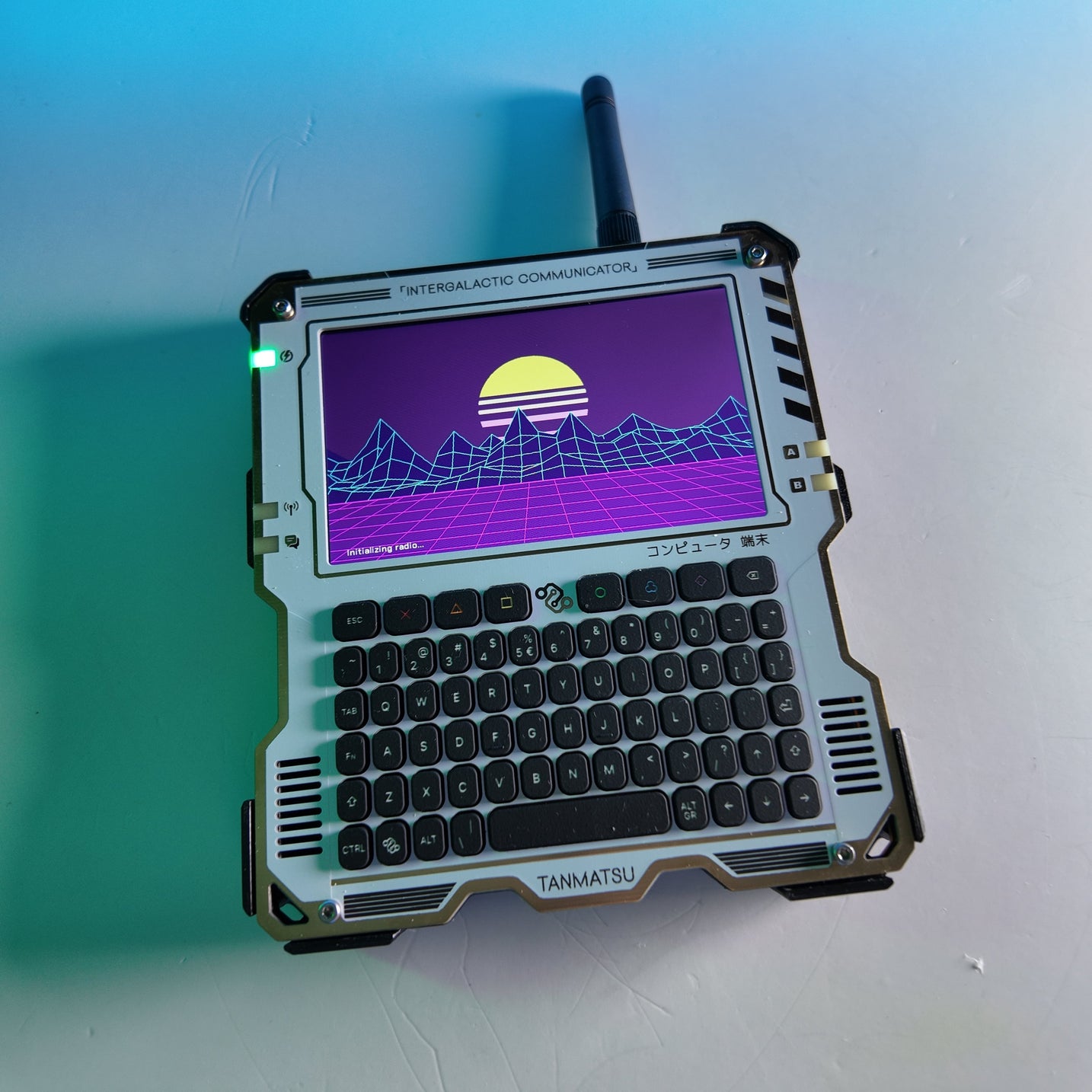
What Is the Tanmatsu?
The Tanmatsu is a small handheld Meshtastic device built for off‑grid communication. It’s not a loose dev board or a DIY mess of wires. It’s a clean, finished unit with a screen, controls, battery, and LoRa radio all built in. You turn it on, and it’s a live node on the mesh.
Who Made It: Renze in Germany
The Tanmatsu was created by a developer named Renze in Germany. He wanted a proper handheld Meshtastic device instead of another bare ESP board with a module soldered on. His design is compact, good‑looking, and actually feels like a real product.
The problem was getting it into the US.
If you lived in the United States, you had to import each Tanmatsu individually from Germany. That meant high shipping, long wait times, and dealing with customs every time. It made the device way more expensive and annoying than it needed to be.
I really liked what Renze built, so I worked directly with him to bring Tanmatsu units into the US in bulk. That makes it way cheaper and easier for people here to get one without fighting with overseas shipping for a single device.
What Is Meshtastic?
Meshtastic is an open‑source project that lets you send short text messages over long range radios instead of using cell service or Wi‑Fi.
You can use Meshtastic for:
- Hiking, camping, and off‑grid trips
- Events and meetups where cell service is bad
- Emergencies and backup communication
- Just having fun with radios and networks
You don’t need a SIM card, data plan, or internet. Devices talk directly to each other.
How It Works with LoRa
Meshtastic runs on LoRa radios. LoRa is a low‑power, long‑range radio system. It’s slow, but it goes far and works in places where normal signals die.
Meshtastic uses LoRa to create a mesh network. That means messages can hop from node to node, not just straight from sender to receiver.
Example:
You send a message on your Tanmatsu.
A node on a hill picks it up.
That node rebroadcasts it.
Someone far away, who can’t see you directly, still gets the message.
Each device can:
- Receive messages
- Re‑transmit them (“bounce” them farther)
- Act as a small repeater in the mesh
So the more nodes people run, the bigger and stronger the network gets.
Tanmatsu Hardware: ESP‑P4 and ESP‑C6
Most Meshtastic builds start with simple ESP32 dev boards and a separate LoRa module. It works, but it’s kind of janky and fragile.
The Tanmatsu is different. It’s built around modern ESP‑P4 and ESP‑C6 chips from Espressif:
- ESP‑P4: Handles the “brain” side of things — UI, controls, screen, and general logic.
- ESP‑C6: Handles LoRa and radio work, plus Wi‑Fi / BLE support where needed.
Because of this setup, the Tanmatsu can run as a true standalone Meshtastic node:
- No phone required once it’s configured
- No USB cables hanging off a bare board
- No external screen needed to see messages
You get:
- Built‑in screen to read and send messages
- Controls for navigation and settings
- Internal battery and charging
- Integrated LoRa hardware tied into Meshtastic
There are not many devices like this. Most “nodes” are still dev boards or half‑finished builds. Tanmatsu is one of the very few handhelds that feels like a finished product out of the box.
Why Bringing Tanmatsu to the US Matters
Before, US buyers had to import single units from Germany. That made the Tanmatsu expensive, slow to arrive, and kind of risky with customs.
By working directly with Renze, I helped bring Tanmatsu devices into the US in a more organized way. That means:
- Lower overall cost per device
- Faster and easier shipping for US customers
- Better access to a solid Meshtastic handheld without DIY headaches
When you buy a Tanmatsu from my store, you’re getting:
- Hardware designed by a small creator in Germany
- A device built around modern ESP‑P4 and ESP‑C6 chips
- One of the only truly standalone Meshtastic handhelds you can just power on and use
It’s a clean way to get into Meshtastic and LoRa without needing to solder, 3D print, or build everything yourself.